Perseids 2020. How to photograph “shooting stars”?

Now that we know where shooting stars come from , and how, where and when to watch Perseids 2020 , let’s consider how to photograph them well?
What are the Perseids?
Probably everyone has heard about the Perseids in recent years. Their photos flood Facebook around mid-August. Perseids are called shooting stars. The vast majority of these are cosmic particles lost by the comet 109P / Swift-Tuttle passing near the Sun. They are named after the Perseus constellation, where they seem to fly in when we look at the sky. We see them in the sky as they fall into the Earth’s atmosphere.
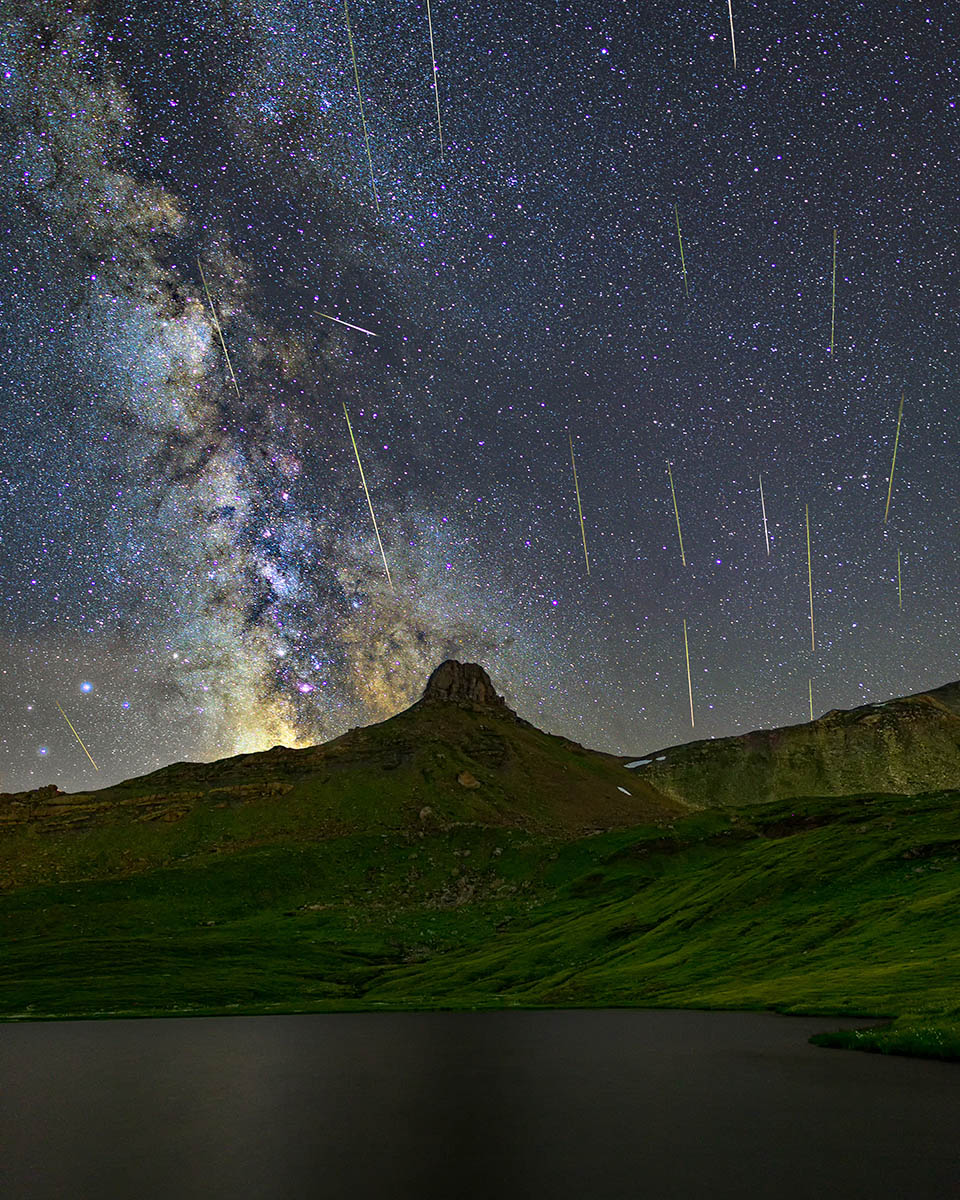
Perseids 2020 – when to observe and photograph them?
The peak of the Perseid swarm in 2020 falls on the night of August 11-12 and August 12-13. And although the perseids will be visible in the sky throughout August, on these two nights there is the best chance to see and photograph them. Theoretically, it will be able to see up to 100 of them per hour. In practice, mostly a place in Poland, we will not notice so many of them.
How to photograph Perseids 2020?
Smartphones have a great camera for everyday photos, but unfortunately they will not work as a camera for photographing Perseids. You will need a normal digital camera.
To photograph Perseids in such a way that they look like long streaks of light, the camera needs to be set to a long shutter speed. A time of 20-30 seconds or more is a good idea.

With such long times, the camera must be set on a tripod – otherwise the photos will be blurred. Any, even a tiny jitter caused by pressing the shutter button can ruin the picture. It is therefore worth releasing the camera remotely, e.g. through a smartphone application or more classically, with a trigger cable or simply a trigger.
Many modern cameras and lenses have an image stabilization function. It’s a great invention, but not if the camera is on a tripod. So let’s remember to turn off stabilization.
Photos of the sky like wide frames, so it’s good to have a lens with a focal length of anywhere between 10-24mm . Thanks to this, we will be able to capture a large range of the sky in the frame. Perseids photos are best taken at low apertures, such as f / 2.8 or even f / 1.4, if our equipment allows it.
What ISO sensitivity? The higher the value, the easier it will be to capture a shooting star. Unfortunately, you have to take into account more noise. In the latest cameras this is not as much of a problem as in the old bodies. So you can check how our equipment is doing from the ISO 800 sensitivity up and choose one where the photos will not be noisy. It’s easier to deal with noise if we save the photo in raw RAW format.
It’s good to focus manually , but it’s not that easy. So you can focus on the moon and lock it there, i.e. simply turn off the autofocus.

If we want attractive photos of the Perseids, it would be a good idea to turn on the time intervalometer , which is a camera function that allows you to automatically take photos at specific intervals. Some cameras have an interval timer, but also some apps for controlling cameras wirelessly. By using this function, not only will we be able to program the cameras to take a series of photos, but also to assemble images from several photos later. In this way we will get many more "shooting stars" in one frame.
Although during the day we experience heat, it gets much colder at night, especially outside the city, where the temperature drops to several degrees Celsius. In order not to get cold, you should dress appropriately, but also take a blanket or a thermos with warm tea or even coffee. We should also take care of the appropriate number of memory cards and batteries so that in the middle of the night in a remote area there is not enough space for photos or power.
Perseids: where to photograph shooting stars?
Theoretically, we can photograph Perseids wherever we want, even a balcony. In practice, the darker it is on the ground, the brighter it is in the sky. It is bright in the city, because we have a lot of lights from street lamps or windows. To get good pictures of the Perseids, you have to go out of town to where it’s dark. It is important to choose a place away from artificial light sources, that is, free from heavy light pollution. Such artificial light limits the number of stars and meteors in the sky we see. So where to look for the best place to photograph the Perseids?
The best places will be dark sky parks, areas designated to protect a unique natural environment from light pollution of the night darkness. These places are far from strong sources of artificial light, so we can admire a truly dark and starry night sky.

If we cannot afford to go to such a place, it is worth going, at least outside the city, away from buildings, e.g. to a clearing in the forest. On the map https://ift.tt/YVNk0C you can see exactly where is the darkest in your area.
Being there, avoid looking at the bright moon or the smartphone screen. Every look at the bright screen or at the bright face of the Moon spoils the accommodation of the eye. When we then turn our gaze back to the blackness of the sky, our eyes will have to get used to it again.
You can use the free Google Sky Map application or other sky observation programs to find the right place in the sky where you can see the "shooting stars", or radian. It is also worth reading what Radek Kosarzycki wrote on this subject in a separate article about watching the Perseids .
Perseids 2020 is a great opportunity for interesting photos and get out of town
The desire to take interesting photos of "shooting stars" may motivate us to go outside the city, do something inspiring, spend time in nature. This is one of the reasons I love photography for – it is often a great motivator to move out of my comfort zone.
Perseids 2020. How to photograph "shooting stars"?

from WordPress https://ift.tt/2XO3NFu


Comments
Post a Comment