Every day, over 1,000 applications are released. I haven t installed a single one for half a year

Good morning, my name is Łukasz and I haven’t installed a single new application for half a year. Considering that there are over 1000 of them every day, I consider it a considerable success, and maybe … a sign of fatigue?
Over the past six months, two new applications have appeared on my smartphones. I deliberately use the words "appeared" here, because that was the case – on Android my account was included in the early release of Android Auto , while on iOS, where I use the Microsoft application, they have been replaced by one Microsoft Office application.
In addition, I haven’t installed a single new program for over half a year, and if I had a good look at the installed applications, I would probably find a few more applications to remove.
When I restore the account from the cloud on a new test smartphone with Android, I see only 31 returning applications.
On the iPhone 11, which I use privately and on which I also keep applications "just in case", 51 applications are installed (not counting the system ones), of which only 21 are pulled out. The rest is hidden in folders, where it waits for occasional use once every few weeks, and sometimes even (in the case of Uber or FreeNow) once every few months.
There was a time when I was obsessively installing and testing every interesting novelty, looking for better versions of existing solutions or just looking for replacements for popular applications out of boredom.
It was not difficult to get into the search. According to Statista data , over 1,400 new items appeared every day in previous years in app stores. The Apple App Store and Google Play Store have 2.2 and 2.8 million apps, respectively. So there is a lot to choose from. The only question is – is it worth it?
Recently, I came to the conclusion that it is not worth it.
The critical point, after which I refused to experiment, was to kill Inbox by Gmail, preceded by the death of the perfect Sunrise Calendar on macOS.
These two events successfully cured me of trust in niche services, especially from the category of the most frequently used e-mail or calendar applications.
For this reason, I have not installed, for example, the Hey application , which "business" is about to grow. Basecamp, which created a new email client, is not a bush company. Rather, it will not disappear overnight, or it will not be taken over by a larger player. But does anyone have such clout to be able to compete with Gmail or Outlook? Of course not.
So I do not see any benefits in installing the application, which will disappear from the market in a few months or years, because it will not be able to build a sufficiently large user base to survive.
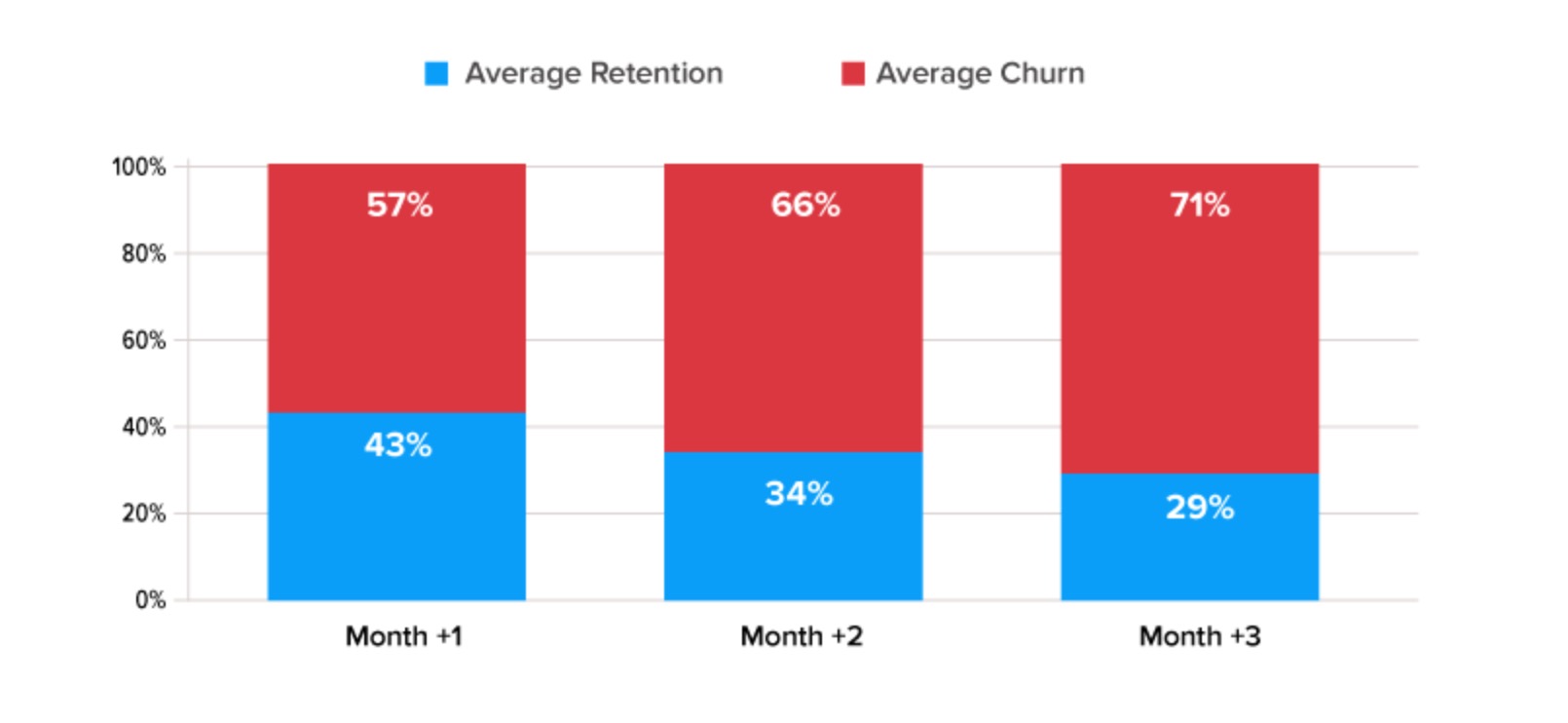
And this is very likely, because according to Statista data, we are quickly bored with new applications. The analysis shows that after three months as much as 71 percent. users who have downloaded the application will stop using it.
Every day, over 1,000 applications are released. How many of them do we really need?
Let’s assume, on average, that 365 thousand saw the light of day last year. application. How many of them have you heard of? How many of them made such an impression on the public that anyone described it, or even installed and checked it?
For the whole of 2019, only one application comes to my mind – FaceApp. And this is only because – as it turned out – while the whole world eagerly aged its image, the application eagerly transferred data to Russian servers (although of course its creators denied it ). Medium to reason for praise.
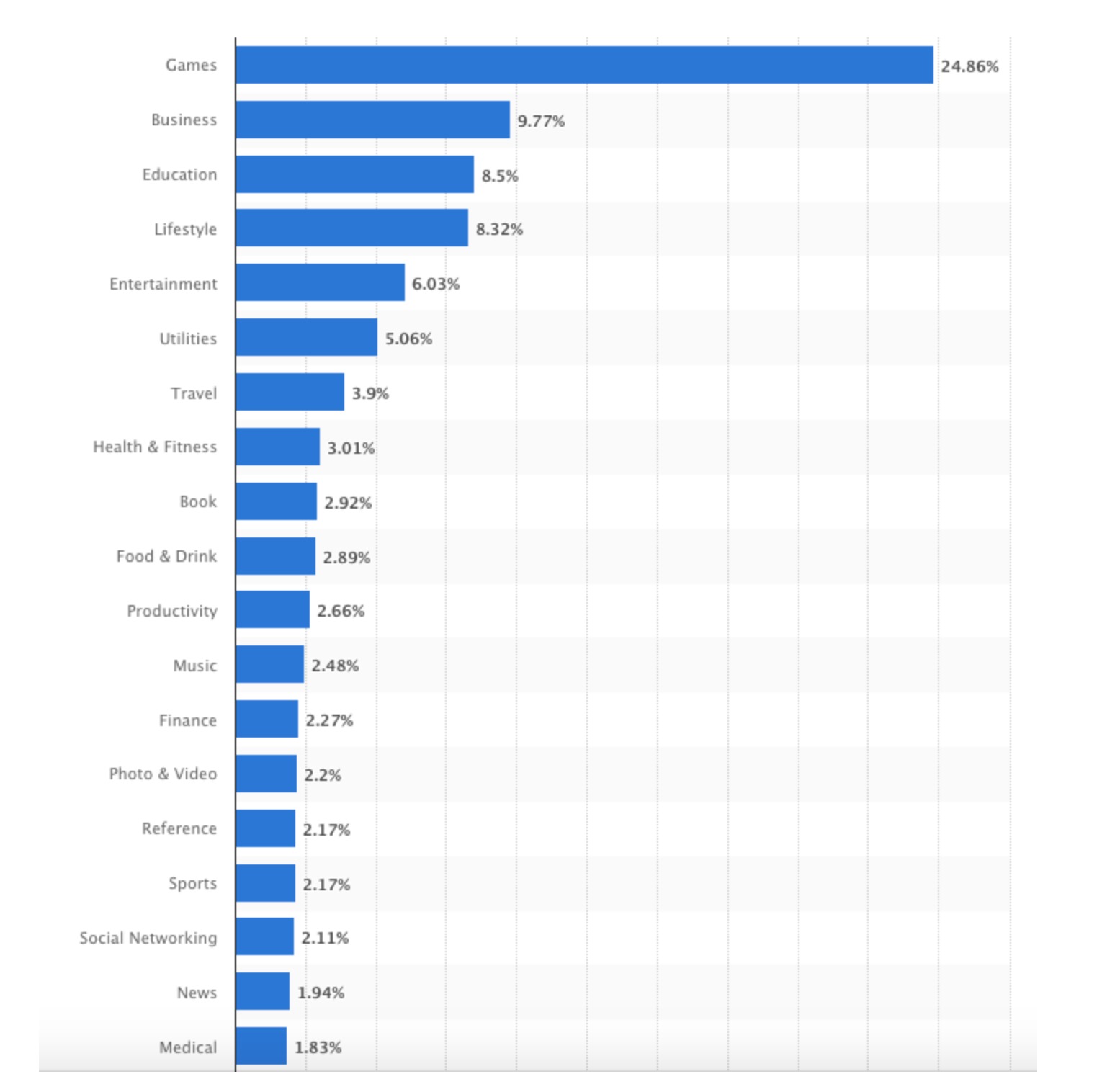
Of course, I’m not talking about games here because they have their own rules. And they constitute the largest percentage of newly emerging applications.
Personally, however, I do not play games on my smartphone at all, I have a PC over games, and on my smartphone I prefer other entertainment – reading / listening to books or watching video.
In fact, research shows that the vast majority of users spend most of their time on smartphones in only 10 applications, and as much as 77 percent. time in TOP 3. Statistically speaking, we launch up to 25 applications every month.

Since we use so few applications, why are new ones still being created?
Because, as the Polish proverb says, if you don’t know what’s going on, it’s about money.
Despite the fact that statistics clearly say that we use only a handful of applications each month, they are still extremely profitable business.
It is estimated that in 2020 alone, mobile applications will generate $ 189 billion. revenue. What is interesting is that the vast majority of them are available for free. They earn revenue in two ways – either by displaying ads to users, or by offering subscriptions or micropayments to unlock additional features.
From year to year, the number of created applications is growing, as is the number of users who download them. Statista experts estimate that between 2018 and 2022 there will be a 25% increase in the number of downloads. As a reminder, in 2018 there were as many as 205 billion (!).

Crash defeat
Why are so many applications created and we use so few?
First of all, because most of the newly created applications do not solve any problem, or solve a problem that has long been solved. By another application, usually doing it better.
To a large extent, this disproportion is also caused by dishonest practices, which neither Google nor Apple have yet to completely eradicate from their platforms. Therefore, for each popular application we will find several clones, ineptly copying its capabilities.
There are also few services that do anything better or even differently. And it must be remembered that a significant part of the thousands of applications released daily are niche programs, e.g. an application connecting with an intelligent hair dryer of a company that no one has heard of.
In the case of my own application restriction, I see another reason – the global "essentialism", which is the limitation of used things to what is really necessary and / or really pleasing to me.
I stopped installing applications that I have no use at all and only use programs that really improve my life or are necessary for work.
And when you approach the topic in this way, it suddenly turns out that such necessary applications really are not many. And having found those that work, there is no reason to look any further.
I deeply believe that just as minimalism has changed in recent months from just a trend to global movement, so next will be digital minimalism.
As a society, we are slowly coming to understand that the digital excess is as harmful as the real one. And it does not matter that the excess of applications or services on the phone does not cause clutter in the room, so we can have them as much as the heart desires – we understand that our things (including applications) occupy not only physical but also mental space.
Every day, over 1,000 applications are released. I haven’t installed a single one for half a year

from WordPress https://ift.tt/3fYb78c


Comments
Post a Comment